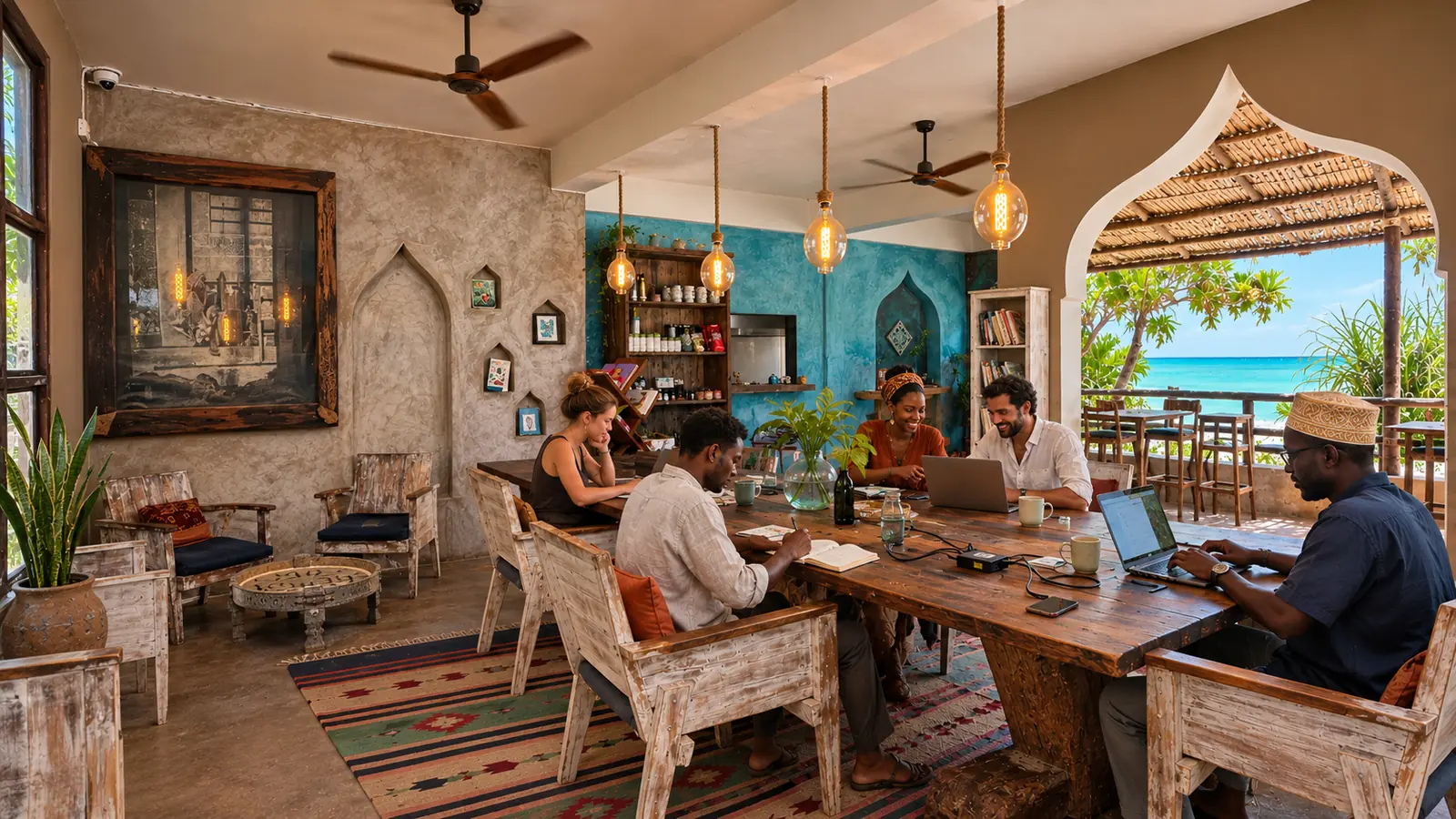
It’s 10:43 in Zanzibar. You’re halfway through a proposal. Across the table, someone’s editing a documentary. A few seats down, someone who runs a local hospitality business is sorting out a booking problem on her phone. You’re surrounded by people from different countries and industries. For most of the morning, the only thing you share is the sound of a fan. You all have work to do.
Then you get up for coffee. You ask her what the call was about. She tells you how she redesigned her booking process for guests who often lose their internet connection. You’ve been trying to make your own onboarding process smoother for months. By the time you sit down again, you’ve crossed out a step you’d always assumed was essential.
How predictable is your workday?
Think about the last ten people you spoke to about work. How many come from an industry you know almost nothing about? A familiar circle is great for getting things done. Spend enough time inside it and you start treating your industry’s habits like rules.
Researchers who interviewed people in coworking spaces found that working near people with different skills gave them opportunities to learn how problems were handled in other fields. A separate set of large LinkedIn experiments found that people were more likely to find a job through certain looser connections on the platform. That finding is about jobs, but it raises a question for anyone sharing a workspace. Who around you knows something your usual circle would never think to tell you?
Stay long enough to be recognised
On an island like Zanzibar, a few weeks in one neighbourhood can give your day a rhythm. You come back to the same workspace, recognise faces on your walk home and pick up a conversation you started two days ago. There’s a difference between passing through and being around long enough for someone to say, “I thought about what you told me yesterday.”
In five studies on living abroad and creativity, psychologists William Maddux and Adam Galinsky found a link between creativity and adapting to life in another culture. That makes the ordinary parts of the day worth paying attention to. Ask how people here do something. Let them show you. Notice which of your usual assumptions still hold.
What could come out of one conversation?
The documentary editor hears how the founder explains a complicated process and asks if she can film it. You offer to test the new booking flow. A week later, you’re comparing notes over lunch. Maybe it turns into a project you work on together. Maybe you leave with a friend, a new way to do your work and a contact you’ll still be calling years from now.
What are you trying to figure out right now? Who at the next table might see it differently?
Explore the Zanzibar map